Tosya Kuznetsova
Yermolai sat on the earthen bench against the wall of his house, hunched over like an old man, leaning on his walking stick. Troubled thoughts weighed heavily on him. His whole life seemed to drift before his eyes.
He had been born here, in this village on the riverbank. Beyond the village stretched the taiga.
His childhood and youth had passed quickly. There had been nothing remarkable about them: everything was ordinary, much the same as for everyone else in the village.
Those were the postwar years, but people in the village had not gone hungry. The forest and the river provided food, and families kept livestock as well.
He had helped his father with the work. They cut hay for the cow to last through the winter and gathered firewood for themselves.
Their amusements were fishing, swimming in the river, picking berries and mushrooms in the forest, and later hunting.
He went to school in a neighbouring village, five kilometres downstream. He considered school a waste of time and never made much effort with his studies.
Then came the army. He served in a military construction battalion.
When his service was over, he returned home.
Young people were eager to work on construction projects, and many moved to the cities.
He stayed in the village.
Then things began to go wrong in the family.
First his mother died on the operating table from peritonitis.
That same year, a falling tree crushed his father while he was working at a logging site. He did not survive, and before long Yermolai had buried him too.
But life had to go on.
He found work at a sawmill and proposed marriage to a neighbour’s daughter, Valentina.
Not because he loved her. He simply believed a man ought to have a family, and there were hardly any unmarried girls left in the village.
This one had caught his eye.
But their married life went wrong almost from the beginning.
Valentina was a fine-looking young woman, capable around the house, and at first she was affectionate towards him.
Yet he wanted to show her how important he was, to display his superiority.
He must still have been a fool back then.
He would not listen to her advice. Instead, he wanted to lecture her.
Once, in his stupidity, he even struck her while trying to prove that he was right.
When he saw her tears, he thought:
“That’s better. Now you’ll know who’s master of this house.”
Valentina said nothing that day.
But after that incident, all her tenderness vanished.
His wife withdrew into herself and lost her brightness.
It was as though dark clouds had gathered over the house.
Of course, he felt guilty, but he saw nothing particularly unusual in what he had done.
How many men in the village gave their wives a beating when they were drunk!
It was practically an everyday occurrence.
She would get used to it too!
A wife needed to be taught a lesson!
Then she would respect him!
But she didn’t.
On the contrary, she began to reproach him.
At the beginning of autumn, a group of students came to the local forestry enterprise for fieldwork.
They said they were going to study the flora and fauna of the area.
That evening, they organised a dance.
Yermolai went along too.
Why shouldn’t he? He was still young.
One of the girls caught his fancy, and he began flirting with her.
Naturally, someone immediately told Valentina.
When he came home, she said:
“You ought to leave those girls alone. They’ve come here to work, not to amuse themselves with you men.”
Oh, how his blood boiled!
Rage surged through him.
How dare she tell him what to do!
That was when he gave his wife a real beating.
Valentina managed to tear herself out of his grasp and ran out into the night.
And he actually took pleasure in the quarrel!
He did not go after her or even try to find her. He simply threw himself onto the bed and went to sleep.
Only in the morning did the village women tell him that Valentina had run to the local medical assistant.
The woman had immediately sent her to hospital.
It turned out that his wife was pregnant.
And he hadn’t even known! She hadn’t told him!
She miscarried. The baby could not be saved.
Valentina never returned to him from the hospital.
She went away to the city.
He did not look for her.
He thought she would wander around for a while, suffer in other people’s lodgings, and eventually come back, begging him to forgive her.
And then he would decide whether to take her back.
But she never returned.
Rumours reached him that she had found a job, married again and had children.
Those rumours stirred something deep inside him and reopened an old wound.
But in public he kept up appearances.
In the evenings, however, he was lonely.
The house was empty, and so was his soul.
To escape that emptiness, to get away from the sympathetic looks of some villagers and the hatred in the eyes of others, he left the village and took a job floating timber down the river.
The river was wide, fast-flowing and full of rapids.
The work demanded tremendous strength.
He worked himself to exhaustion.
One day he realised that he was deliberately seeking out difficulties, almost as though he wanted to die.
But apparently he had been born under a lucky star.
He overcame every hardship, scarcely even noticing it.
Well, wasn’t life itself like the shallows and rapids of a river?
Sometimes it flowed smoothly, and sometimes obstacles appeared in its path.
His father had told him that when he was a child, and he had seen it for himself.
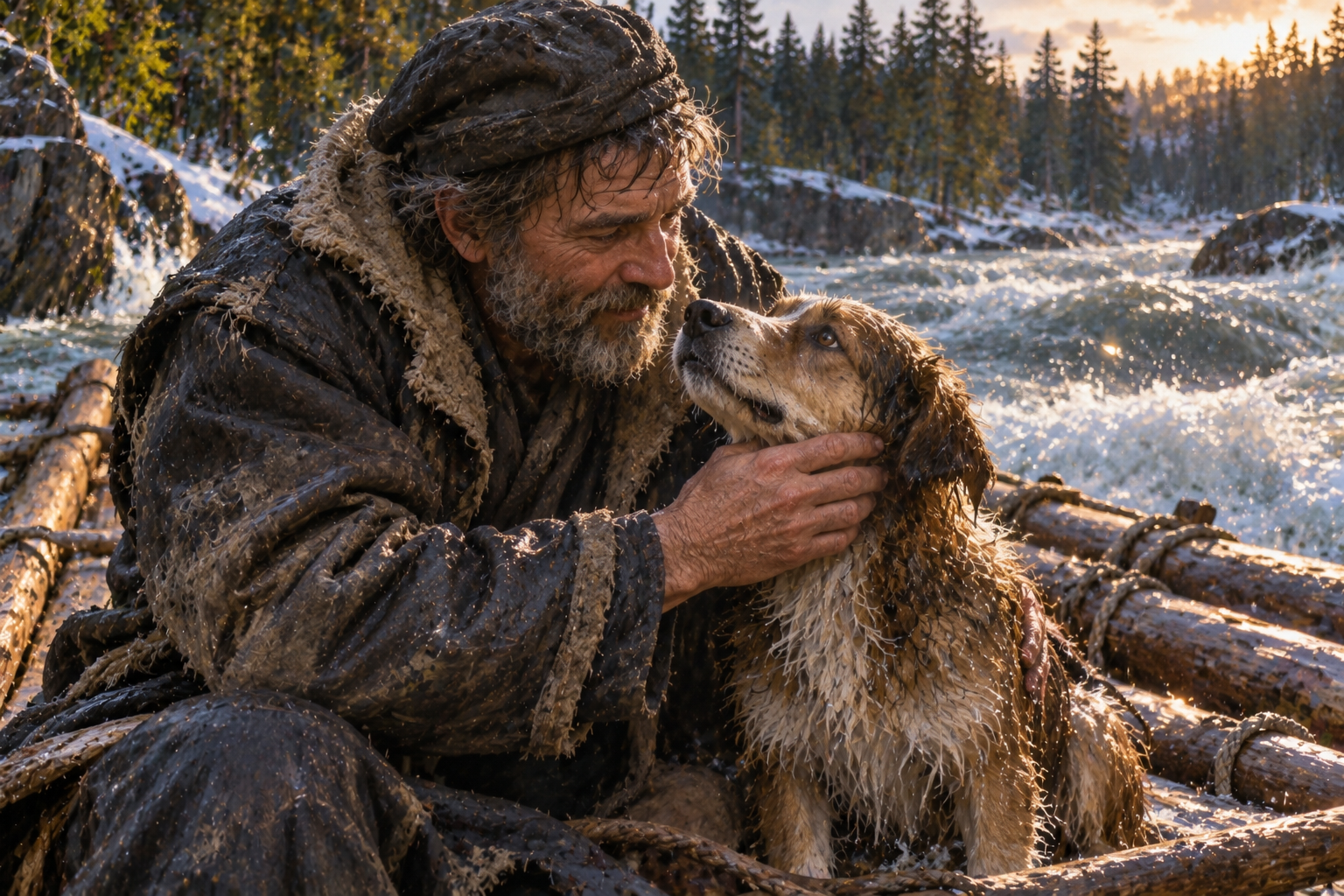
One day, while passing through a stretch of rapids, he noticed a dog standing on a rock.
It was staring at the whirlpool churning around its feet, unable to bring itself to jump into the water.
How had it ended up in the middle of the river?
How long had it been standing there?
Yermolai steered his timber raft towards the rock and managed to pull the dog aboard.
Wet and trembling, it pressed itself against his legs.
He stroked it.
The dog wagged its tail gratefully and licked his hands.
Perhaps that was the first time in his life he had felt something resembling love.
Or perhaps it was simply pity for the poor, shivering animal.
And so two lonely creatures found each other.
From that day on, they were inseparable.
He named the dog Zhulka. Long ago, at school, he had read a story about a dog with that name.
Before long, Zhulka was no longer afraid to run about on the raft.
Whenever they moored by the riverbank, she raced happily around the surrounding countryside.
Yermolai listened to her joyful, ringing bark and felt as though his soul were beginning to thaw.
Sometimes Zhulka returned with prey: a hare she had caught or a partridge.
He praised her, cleaned the game and put it into the cooking pot.
Then they settled beside the campfire and ate their soup with pleasure.
Meat soup made a welcome change from their everyday diet of fish.
Zhulka had a bowl of her own.
And that was how the two of them began living together.
When winter came and the timber-floating season ended, they returned to the village and spent the cold months there.
Yes, Zhulka saved him from loneliness, from the emptiness of his house.
She became a true friend.
But time went on, and the years flew by.
Then one day his Zhulka died, almost in his arms.
No, she had not died of an illness. It was simply that a dog’s life, sadly, is much shorter than a human being’s.
He buried her cold body himself beside the cemetery fence.
He decided that whenever he visited his mother and father’s graves, he would stop by Zhulka’s too and leave a little bone on her grave.
He grieved terribly for her!
Valentina had never found her way into his heart as deeply as Zhulka had.
And once again loneliness overwhelmed him.
He fought against it, tried to lose himself in his work, but came to realise that he too had grown old and that his strength was running out.
Lately, Zhulka had begun appearing to him in his dreams at night.
She wagged her tail happily and beckoned him to follow her.
Apparently it was time for him to leave this world too.
And he did not object.
After all, everyone had to go there someday.
But other thoughts gave him no peace.
Why had he lived?
What was he leaving behind on this earth?
And to whom could he leave anything?
Look at the other men his age: their grandchildren ran through the village, playing hide-and-seek and war games, nursing their dolls, filling the village silence with laughter.
And what did he have?
He had lived alone, and he would die alone.
Strangers would bury him.
Perhaps this was his punishment for marrying a woman he did not love, for failing to appreciate his wife’s care, for raising his hand against her.
He had dreamed of having a family, yet had failed to preserve it.
He had deprived his child of the chance to be born!
Valentina had never heard a single tender word from him!
His life had passed, and he still had not understood why it had been given to him.
What had life turned out to be for him — a reward or a punishment?
A punishment, most likely, since he was filled with remorse.
But it was too late!
His life had proved worthless, empty and wasted.
And there was nothing he could do to put things right!
In the dim light before dawn, young people were making their way home after a dance.
One young man noticed an old man slumped against the wall of a neighbouring house and called out:
“Hey, Granddad, are you sleeping outside? Go on home!”
There was no answer.
The young man called out again, more loudly:
“Granddad, you haven’t died, have you?”
The old man did not move.
The young man did not dare approach him. Instead, he quickened his pace.
Near his own house, he saw his mother coming out to milk the cow and told her that their elderly neighbour had died.
His mother adjusted the headscarf she was wearing, crossed herself and said quietly:
“Poor soul. His suffering is over.”
May 2024